

Jim Creighton: Baseball’s First Superstar

Joined
Aug 26, 2011
Messages
867
Location
Land of the Savages
Until the introduction of strikes just a year prior, pitchers were only a cog in the machine that was a baseball game.

That day, Creighton utilized speed that had never been seen before in baseball. He would deliver pitches with such velocity that opposing managers argued that what he was doing was illegal. According to accounts at the time, Creighton was throwing illegal pitches by snapping his wrist, but it was so slight it couldn’t possibly be picked up by the human eye. In addition, Creighton introduced pitches with spin, as well as a slower pitch called “the dew drop.” Although he was not the first to attempt to add speed, Creighton was the first to successfully and consistently control it. With the introduction of the “strike” just a year before, this was a perfect storm that led Creighton to become the best pitcher baseball had seen to that point.

Creighton’s 1862 season may have been his finest. Both at the plate and on the bases, he was put out only four times. His spectacular pitching continued. However, this season would end in tragedy for Creighton.

On October 14, 1862, Creighton was experiencing another great game, this time against the Unions of Morrisania. In the first five innings, he was 4-for-4 with 4 doubles, as well as a flawless second base. In the top of the sixth inning, he came in to pitch in relief. In the bottom half of the inning, according to those witnessed to the event, Creighton belted a home run in his fifth at bat. But, this home run would turn out to be deadly.

John Chapman, a witness to the game, wrote 50 years later: ““I was present at the game between the Excelsiors and the Unions of Morrisania at which Jim Creighton injured himself. He did it in hitting out a home run. When he had crossed the [plate] he turned to George Flanley and said, ‘I must have snapped my belt,’ and George said, ‘I guess not.’ It turned out that he had suffered a fatal injury. Nothing could be done for him, and baseball met with a severe loss. He had wonderful speed, and, with it, splendid command. He was fairly unhittable.”

In the early days of baseball, a baseball swing involved keeping one’s arms completely straight and violently torquing the hips and abdomen through. It was believed that Creighton swung with such violence that it caused a ruptured inguinal hernia (at the time it was credited as a ruptured bladder).

For the next four days, Creighton suffered from hemorrhaging and internal bleeding. He would pass away on October 18, 1862 at the age of 21. He is buried in Green-Wood Cemetery in Brooklyn. A 12-foot marble obelisk stands at his burial site.

Creighton is considered by many historians and baseball enthusiasts as the game’s first superstar. He was involved in many firsts within the game, outside of the evolution of the fastball. Creighton also helped in turning baseball’s first recorded triple play on September 22, 1860, and threw the first recorded shutout on November 8, 1860. In addition, he also put up staggering numbers for his time.

Read more at:
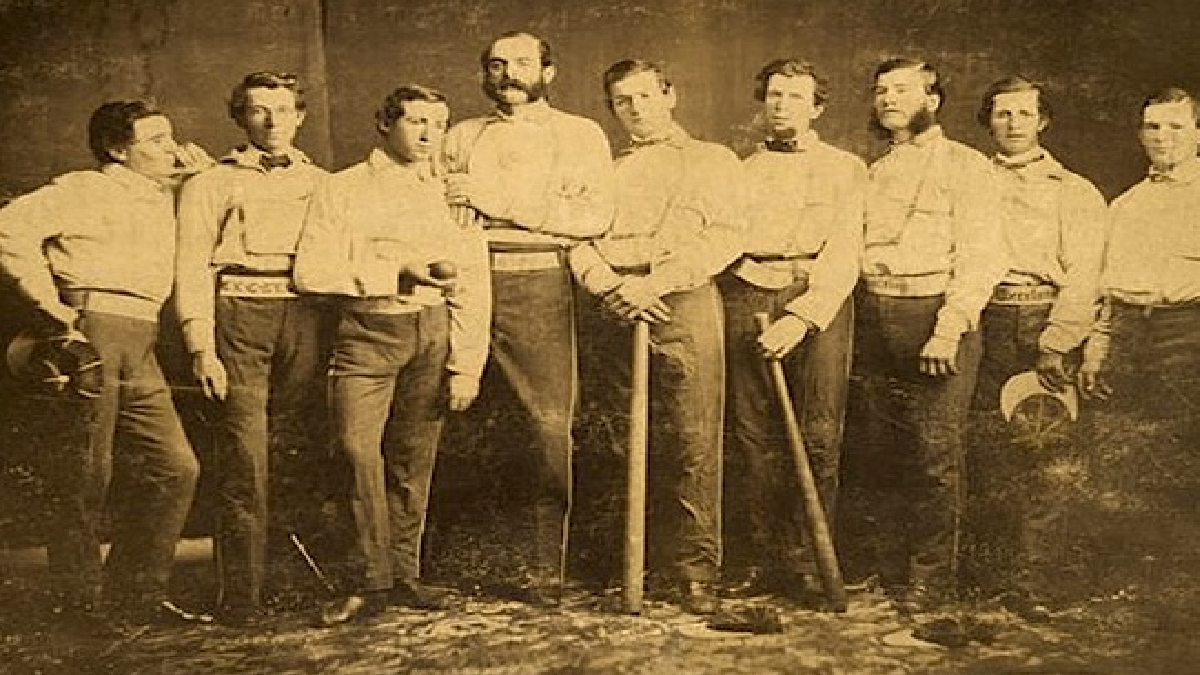
 
Jim Creighton was the stellar pitcher of his day, even at his young age. He pitched six years before there was any Major League Baseball (1857-1862). He was born in New York City, which was the epicenter of the baseball world at the time, to James and Jane Creighton. He played for the Brooklyn Stars (1859); the Brooklyn Niagaras (1859) and the Brooklyn Excelsiors (1859-1862).

Also well known as a cricketer, Creighton was recruited from the Brooklyn Star Club, the Excelsiors being dazzled by his "unhittable delivery." With him pitching almost every game, they won 18 out of 21, holding their opponents to 7.2 runs per game, a record-setting pace for the era. But then tragedy struck, ironically, with him at the plate. He swung so mighty a blow in the manner of the day, with hands separated on the bat, little or no turn of the wrists, and incredible torque applied by the twisting motion of the upper body, that it was reported he ruptured his bladder (later review of the circumstances, aided by modern medical understanding, pointed to a ruptured inguinal hernia).

After four days of hemorrhaging and agony at his home at 307 Henry Street, Jim Creighton passed away at the tender age of 21 years and 6 months, having given his all to baseball in a final epic blast that Roy Hobbs (the cinematic one, that is) might have envied. He, like so many others, is buried at Greenwood Cemetery in Brooklyn, New York with his grave marked by a granite obelisk adorned by a marble baseball, although the oversized baseball that sat on top of his monument has long since disappeared.


James Creighton, Jr. (April 15, 1841 – October 18, 1862) was an American baseball player during the game's amateur era, and is considered by historians to be the sport's first superstar and one of its earliest paid competitors. In 1860 and 1862 he played for one of the most dominant teams of the era, the Excelsior of Brooklyn. He also was reputed to be a superb cricketer, and played in many amateur and professional cricket

Early life
Creighton was born on April 15, 1841 in Manhattan to James and Jane Creighton, and was raised in Brooklyn.[2] By age 16, he had become recognized in the Brooklyn area for his batting skills in both baseball and cricket. In 1857, along with other neighborhood youths, he formed a local baseball club named Young America.[3] During this period, there were no organized leagues and few competing teams, so amateur clubs spent much of their time practicing and playing intra-squad games, with occasional matches against rivals. Young America played a few match games before disbanding. Creighton then became a member of Niagara of Brooklyn, playing second base.[3]

Discovery by the Star Club
In a match on July 19, 1859, the Niagaras were being heavily outscored by the Star Club of Brooklyn. Creighton, who had thus far been used by the team primarily in the infield, was brought on as a substitute pitcher.[2] Using what observers described as a "low, swift delivery," Creighton achieved uncommonly swift velocity. With the balls "rising from the ground past the shoulder to the catcher," the Star batsmen were unable to hit them effectively.[4] Under the rules of baseball at the time, a pitcher was required to deliver the ball underhanded with arm locked straight at the elbow and at the wrist.[5] Another technique he used was to give the baseball spinning motion, making it harder for the batters to hit it squarely.[6] Additionally, he threw a high-arcing slower pitch called a "dew-drop."[5] It was the job of the pitcher to make it easy for the batter to hit the ball as fielding was considered the game's true skill.[6] Star batsmen claimed that Creighton was using an illegal snap of the wrist to deliver the pitch. The Star Club eventually won the game, but following the match, Creighton left the Niagaras and joined the Stars.[3]

Before the 1860 season began, Creighton left the Star Club and joined one of the highest-profiled clubs in the game at the time, the Excelsior of Brooklyn.[3][7] With their new star pitcher, the Excelsiors became a national sensation. They organized the first known baseball tour outside of their home region, taking on teams along the East Coast of the United States.[3] That first season, Creighton scored 47 runs in 20 match games, and was retired just 56 times and did not strike out. In a game against the St. George Cricket Club on November 8, he recorded baseball's first shutout.[8] In addition to his pitching skills, he became the game's best batter. In 1862, he batted 1.000, getting hits in all 65 of his at-bats. (The Excelsiors, along with most organized clubs, did not play ball in 1861, as countless players of military age enlisted to fight in the Civil War.)

Pitching style
When observing Creighton bowling in a cricket match, English cricketer John Lillywhite commented, "Why, that man is not bowling, he is throwing underhand. It is the best disguised underhand throwing I ever saw, and might readily be taken for a fair delivery."[2] Another observer said that his pitch was "as swift as [if] it was shot out of [a] cannon."[5] Excelsior teammate John (a.k.a. "Jack") Chapman later in his life wrote that Creighton "...had wonderful speed, and, with it, splendid command. He was fairly unhittable." Others, especially more tradition-minded members in the baseball community, complained that not only were his pitches illegal, but also unsportsmanlike.[9] After Creighton held the famed rival Brooklyn Atlantics to five runs, an extraordinarily low total for the era, the Brooklyn Eagle dispatched a reporter to determine whether or not his pitch was legal. The journalistic witness reported that Creighton was throwing a "fair square pitch", rather than a "jerk" or an "underhand throw."

Cricket
Creighton was considered a prominent member of the cricket community, playing both amateur and professional. He performed for the American Cricket Club in both 1861 and 1862, often playing against the all-England team, whether at Hoboken's Elysian Fields or elsewhere.[3] Though the English teams would dominate these matches, Creighton fared well. In an 1859 match of 11 Englishmen against 16 Americans, he clean bowled five wickets out of six successive balls.[2]

Death
There has been some historical controversy about the circumstances of Creighton's death. On October 14, 1862, Creighton played second base in a match on the Excelsior Grounds against the Union of Morrisania club, while Brainard pitched. Creighton had allegedly hit four doubles in four at bats during the first five innings. As chronicled 50 years later by a witness to the game, Jack Chapman, Creighton took over pitching duties from Brainard in the sixth inning, and in his next at bat hit a home run. While swinging the bat, he allegedly suffered an injury in his abdominal area.[notes 1] According to Chapman, when Creighton crossed home plate, he commented to the next batter, George Flanley, that he heard something snap.[12] After the game, he began to experience severe pain and hemorrhaging in his abdomen. He died in his father's home on October 18 at the age of 21.[13] In an 1887 issue of an early sports newspaper, the Sporting Life, a letter-writer, who signed only as "Old Timer", sent in his account of the event.[14] This account reported it as a ruptured bladder; in the light of modern medical understanding, the injury was most likely a ruptured inguinal hernia.

However, subsequent research indicates that Creighton's death by hitting a home run was fabricated years later to dramatize his martyrdom. "Dying while hitting a long home run is a great story; it's just not true," said Tom Shieber, senior curator of the National Baseball Hall of Fame.[15] Shieber researched original news sources and found no references to Creighton hitting a home run in that game. The death-by-home-run myth was popularized, and probably started, five decades later by Chapman. Alfred H. Spink's 1910 book The National Game quoted Chapman as saying, "I was present at the game between the Excelsiors and the Unions [sic] of Morrisiana at which Jim Creighton injured himself. He did it in hitting out a home run. When he had crossed the rubber [i.e., home plate] he turned to George Flanley and said, 'I must have snapped my belt.'"[16] Countless historians have refuted this legend, but it has taken root as factual.

Later research has suggested that Creighton's hernia was chronic, and that the tremendous workload from baseball and cricket contributed to worsening the hernia. In that era, balls and strikes were not called, and batters who could not hit Creighton's rapid deliveries adapted by refusing to swing at good pitches, forcing Creighton to throw well over 300 pitches per match. Pitching with great force and the exaggerated body contortions necessary to achieve high velocity exacerbated his condition.[17]

Creighton's death caused concern in the sports world that public perceptions of baseball and cricket would focus on the inherent dangers of their play, hurting the sports' popularity. Though it is generally accepted that Creighton fatally injured himself while playing baseball, it was reported that the Excelsior president, Dr. Joseph Jones, made comments during the National Association convention of 1862 that constituted an attempt to "correct" this notion. He claimed that Creighton had suffered the injury, instead, while playing cricket in a match on October 7.[18] Later research claims that Dr. Jones' assertions are correct; Creighton had died of a "strangulated intestine", and did not hit a home run during his final game.[19] Dr. Jones' remarks have been interpreted as his attempt to save baseball's image, and its nearly equal standing with cricket, as well as his team's legacy after losing their best player.[3] Baseball at the time was constantly "looking forward", and Creighton's death provided the sport with a certain mythology and much-needed nostalgia.[18]

Baseball writer John Thorn commented in his book, Baseball in the Garden of Eden: The Secret History of the Early Game, that Creighton "was baseball's first hero, and I believe, the most important player not inducted into the Baseball Hall of Fame."[2]

At the time, the sport of cricket was the most popular team sport in the United States, but Creighton and the Excelsiors had brought considerable attention to baseball. Creighton's popularity grew substantially after his death.[19] In the following decade, teams began honoring him by naming themselves after him, and others paid tribute by visiting his gravesite.[18] As long as twenty years later, though the public adored their star pitchers, comparisons to Creighton would inevitably emerge. It was not considered controversial to compliment a pitcher with the caveat that he "warn't no Creighton."[21] For years following his death, the Excelsiors' program included a portrait of their team with Creighton, shrouded in black, featured prominently in the center.[21]

Creighton's indirect legacy is perhaps most profoundly seen in what is now considered a fundamental component of the game: the called ball and the walk. Neither existed during Creighton's lifetime, but his many imitators, who pitched with Creighton's velocity but not his control, prompted batters to stand at the plate without swinging for lengthy intervals, waiting for a pitch within reach. Consequently, the sport's then-governing body, the National Association of Base Ball Players, introduced a rule for the 1864 season which penalized pitchers who repeatedly failed to deliver "good balls:" the called ball, three of which gave the batter a free pass to first base.

Only two photographs of Creighton are known to exist, one of him posing as a pitcher, the other as a member of the Brooklyn Excelsiors.

 
American Freedom News
Back
Top